







In the morning, stowing gear into his rucksack inside a SANU 2nd Home cabin, his movements were calm. Outside the window, only forest. Having woken up already inside nature, preparing for the climb feels less like packing for a trip than an extension of daily life. The destination is Mount Iō, one of the Yatsugatake peaks. Having long considered homes built within nature, how does Anzai view nature itself?
A Living Network of Trees
Leaving SANU 2nd Home Yatsugatake 3rd, it takes about an hour by car to the Mount Iō trailhead. As green passed outside the window, Anzai spoke up:
“When I look around at different flora and fauna, I find myself contemplating how they evolved into the shapes they have today. There’s a reason for everything; the shape of a single leaf, the way a branch extends.”
To know is to build. Dwellings powered and watered as much as possible by the elements themselves: this idea, he says, has already begun to sprout.
Stepping out of the car at the trailhead, the air turned noticeably colder. Shortly after setting off on foot, he paused. “Smell that sweet scent? Katsura.” Right beside us stood a single tree, its leaves shaped like hearts.
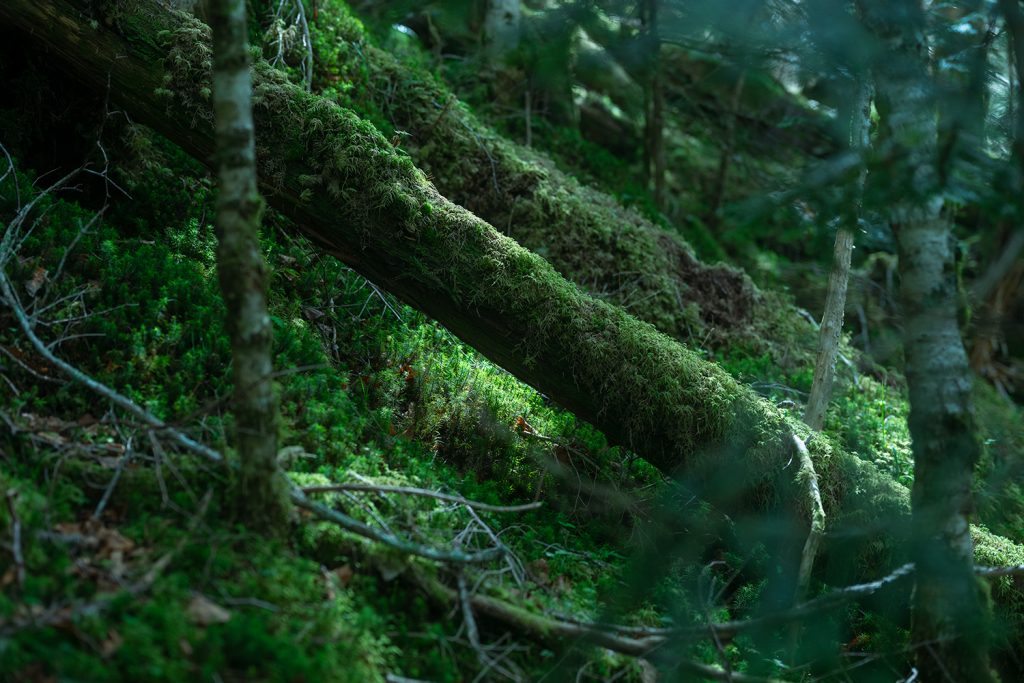
The trail initially weaves through a mossy coniferous forest. To his eyes, the forest is no simple mass of green. Each plant has its own way of surviving: some lure birds with ripe fruit to scatter their seeds afar; others launch downy fluff into the wind; still others drop seeds into streams, entrusting them to the current. Unable to move, plants have evolved by drawing on their own innate strength.
Trees with radically different natures share the same slope, giving space to one another. Once you know their names and character, trees previously lumped together as generic brush stand out in sharp relief.
“The forest is really just a society made of countless living things. Every tree lives by its own strength, but they still make room for each other. Looking at it like that makes it pretty fascinating, doesn’t it?”
Hearing that, the forest overhead suddenly looked entirely different.
Forms Only Nature Can Create
After walking a while, we came upon a river. Heavy rain had fallen the day before, yet the flowing water was remarkably clear. It was proof, he explained, that the forest had caught the rain and filtered it slowly. The stream at our feet would eventually join other waters, pass through countless lands, and pour into the sea. This single clear thread connected to life in distant, unseen places.

Small and large stones lay scattered along the path. Anzai picked up a sharp one and set it on his palm. Its sharp edges showed where lava met water and cooled instantly, hardening like glass before shattering. Mount Iō is a mountain born of volcanic activity. Every pebble is a fragment of lava spewed out in primeval times, bearing within itself an unimaginable scale of time. No two are identical. Looking down at the stone, his expression softened.
“When people try to create something, intention always creeps in. The shapes that really fascinate me are the ones where human design has no place at all.”
If snow piles high, what angle should a roof take? Where does the rain find its path? Design hints lie scattered everywhere. “Maybe we go into the mountains not to search for answers, but to double-check the ones we have.” What he learns lives on in the SANU structures he has built. Rather than asserting the architecture itself, it settles seamlessly into the forest. Standing in nature, you look at the whole and simply see something beautiful.
Understanding Shifts the Scenery
The path gradually turns steep. Before you know it, the surrounding trees grow short, the greenery thins, and rugged rock faces emerge. High mountains have a tree line, a boundary beyond which trees cannot thrive. As you pass it, the clouds feel remarkably close along the ridge. Clouds that were just distant sky from the foot of the mountain now loom overhead, casting huge shadows that drift slowly across the green slopes.
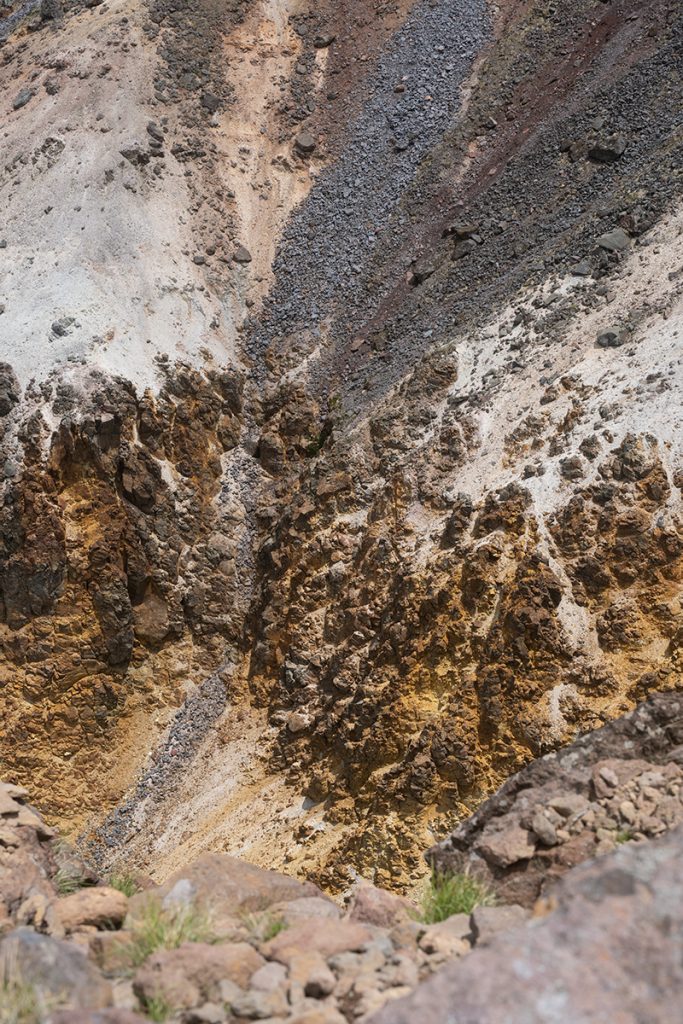
Suddenly, the view opens up. This is the summit of Mount Iō, standing 2,760 meters above sea level. Below, a gouged crater gapes wildly. Carved out by ancient eruptions, this massive cross-section, roughly a kilometer across, bears silent witness to how the mountain came to be.
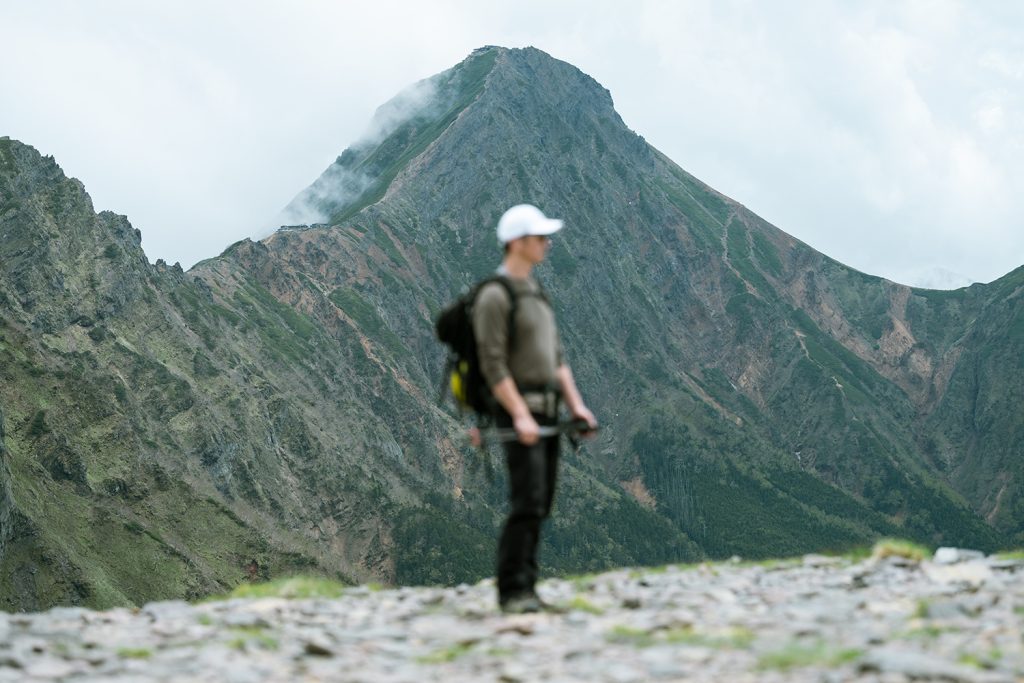
I lifted my head and took in the panorama. The peaks of the Yatsugatake range stretch out endlessly. Standing regally in the very middle of these sheer, crowding mountains is Mount Aka, rising even higher than where we stood now. Gazing up at it, we felt the quiet weight of aeons, far longer than the time carried by the plants and stones.
Looking back, the slopes we climbed stretch far below. I traced the clouds to read the wind, and gazed down to see where rivers run and waters gather. The town we walked, the river where we paused, and the sweet-scented forest all melted into a single, seamless view.
Just a bit of knowledge can make a familiar landscape look entirely different. Walking Yatsugatake together, the mountain revealed itself as a single living organism, full of things yet unknown. Anzai stared at the towering Mount Aka for a long moment before finally speaking.
“There are countless mountains and landscapes across Japan and around the world I have yet to discover. That is what keeps driving me back out to find them.”
Heading out to find the unknown. The door is always open right before you.
Kotaro Anzai
Born in 1977 in Nihonmatsu, Fukushima, Kotaro Anzai is the third-generation head of Anzai Construction. In 2006, he founded ADX (formerly Lifestyle Koubou) to pursue sustainable architecture in harmony with nature. He specializes in dynamic timber design, drawing on a lifetime of deep engagement with wood to push the material’s possibilities. As a Wood Creator, he lectures at universities and companies worldwide. Mountaineering is his life’s work.
SANU 2nd Home Yatsugatake 3rd
8240-980 Nishiide, Oizumi-cho, Hokuto, Yamanashi 409-1501
【SANU 2nd Home】
Live with nature.
SANU 2nd Home is a service that offers uniquely designed shared vacation homes—
“a second home in nature”—located amidst beautiful natural settings across Japan.
Moving back and forth between the city and nature,
and it gradually become part of the local daily life.
Based on the concept of “Live with nature.”,
SANU proposes a new lifestyle.
SANU currently operate 241 rooms across 37 locations nationwide (as of August 2026).
Its network spans from Niseko, Hokkaido, to Amami Oshima,
and it plans to expand to over 100 locations both domestically and internationally by 2029.
As its network grows, SANU enrichs both nature and the local communities, and cherish the regenerative approach.
Reservations & Inquiries
https://www.sa-nu.com/