







On a Boat to Everywhere
As a child, I used to swim in Lake Biwa each summer. That may be why I grew up feeling more attached to lakes than to the ocean. On the day the COVID-19 voluntary restrictions on travel between prefectures was lifted, I took a trip to the Mikata Five Lakes by the coast of Wakasa Bay on the Sea of Japan. The hills offered a sweeping view of the gentle connection between the lakes and the sea. The Hiruga near the coast is saline, the Suga farther inland is brackish… All of the five lakes differ in water quality and would have appeared different in color on a clear day.

This area is the site of the Torihama shell mound dating mainly to the Early Jomon period (about 5,500 years ago). You may have heard about the dugout canoes found among the artifacts. A dugout is a boat made from a hollowed-out tree. Though incredibly simple in construction, the material itself is buoyant, so there’s no worry about the vessel sinking, plus it’s resistant to rot and damage. Several dugouts dating to the Late Jomon (about 4,400–3,200 years ago) and Final Jomon (3,200–2,500 years ago) were also unearthed at the Yuri site, not far from the Torihama shell mound, indicating the boats were made over a long period of time around the Mikata Five Lakes.

Pottery, stone tools, and lacquered items—many artifacts from the Torihama shell mound are on display at the Wakasa History Museum. I asked the curator to show me the dugout canoes along with the stone axes and their wooden handles (both collection of the Wakasa History Museum) believed to have been used for felling the trees and hollowing out the logs. How amazing that even the tools were found! As I examined the brilliant crystallizations of wisdom, in my mind I was picturing a scene from a trip I once took to Inle Lake in Myanmar, where I met the local fishermen who skillfully controlled their paddle with one leg as they did their fishing. Up close, you see, the Jomon dugouts had a remarkably shallow bottom out of proportion with their length.
Take those pictured here found at the Yuri site (collection of the Wakasa Mikata Jomon Museum). From front to back, they measure 5.22 meters, 5.8 meters, and 4.9 meters long, but each is not even 10 centimeters deep. The boats I saw at Inle Lake were similar in shape, and rowers young and old paddled out with natural ease, glided over the water surface, and faded away into the twilight. To think that memory would resurface here. Judging from the scant depth, these boats were probably not reliable enough for heading out into the open sea, but they were perfect for getting around across and between the lakes. The dugouts found in Mikata, incidentally, were made from Japanese cedar trees.
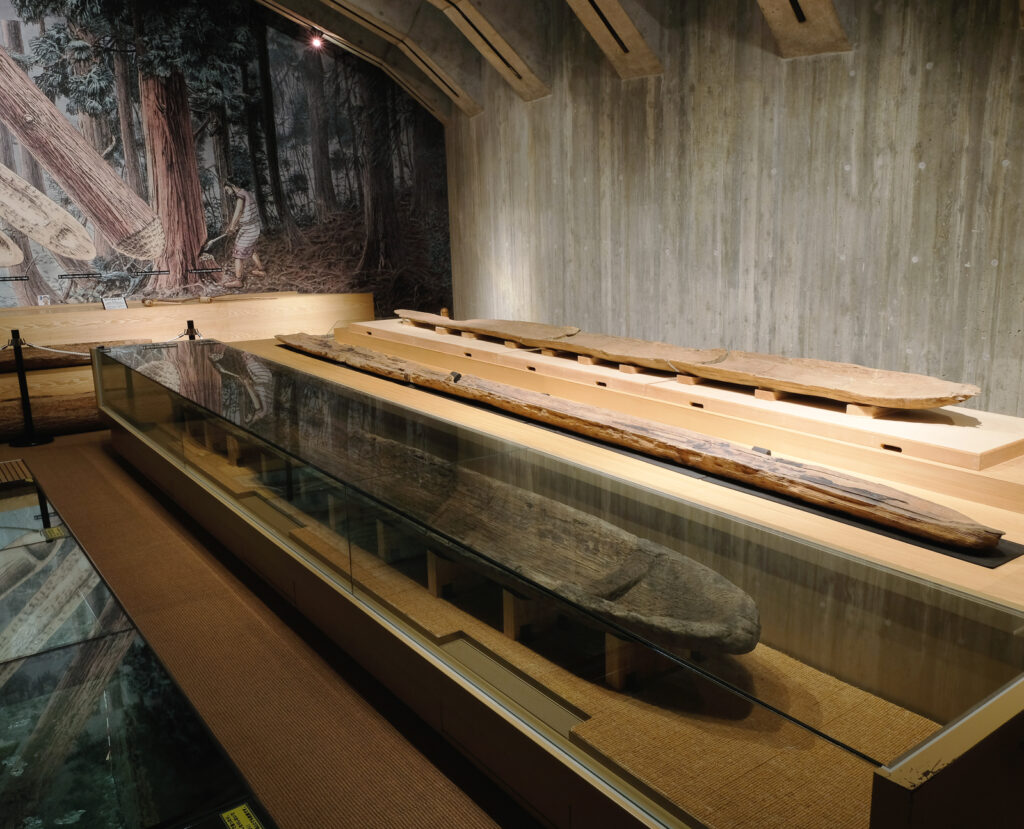
A boatbuilder back at Lake Biwa once told me that his work begins by going into the forest and selecting a tree. I imagined the Jomon people also beginning by walking the forest in search of the perfect tree for their dugout canoe. The completion of a boat marked the creation of a link between the forest and the sea—I learned that on this trip.
With these thoughts running through my head, I drove around Lake Mikata and spotted a row of boatsheds lining the shore. On closer look, the sheds’ thatched roofs were restored and provided cover for boats of both unfinished wood and coated materials. It started drizzling, and as I waited for the rain to pass, I met a man from the Kitajo area who said he ran a fruit orchard. I asked him about the life around the lakes. Until about sixty years ago, the roads were still only wide enough for three-wheeled mini trucks dubbed Batako, and the main mode of transportation was by water. “We couldn’t go anywhere without a boat,” he said. To the ume plum orchard, to the rice paddies, and to the Suijin Matsuri festival dedicated to the god of water—the residents paddled everywhere. Some of those boats are still in service today. The man’s story instantly brought into focus the life in the Jomon.

I had seen an old document with a map depicting a paleolake called Lake Ko-Mikata (Old Mikata). According to that map, there was an even larger lake right around this area in the Jomon period. In fact, I was standing in a former lake. Off we go, then, on a boat to everywhere!
< PAPERSKY no.63(2020)>
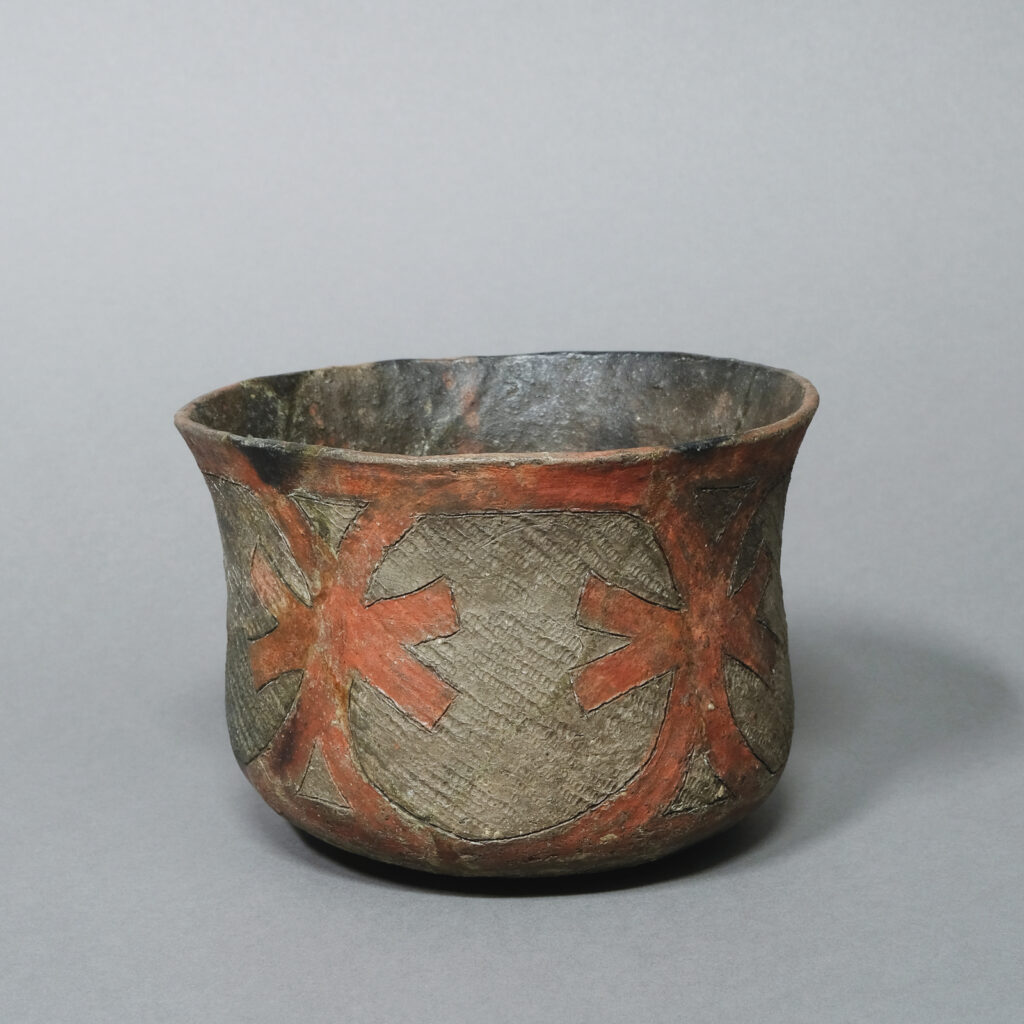
Jomon Fieldwork | Nao Tsuda × Lucas B.B. Interview
A conversation between ‘Jomon Fieldwork’ Photographer and writer Nao Tsuda and Papersky’s Editor-in-chief Lucas B.B. The two discuss the ways Jomon culture continues to play an important role in modern day Japan. The video was filmed at Papersky’s office in Shibuya in conjunction with Tsuda’s exhibition “Eyes of the Lake and Mother Mountain Plate” held at the Yatsugatake Museum in Nagano.
Nao Tsuda | photographer
Through his world travels he has been pointing his lens both into the ancient past and towards the future to translate the story of people and their natural world.
tsudanao.com