







This variety of natto, the fermented soybean delicacy, isn’t sticky or stringy. Chew on a black bean, and the sweetness of soy and the savory flavor drawn out by fermentation fills the mouth. Bite into a piece of karakawa, and the spicy flavor of Japanese pepper causes a tingling sensation.
Hamanatto has long been produced at Buddhist temples to provide nourishment for the priests, who were not allowed to eat meat. Light and easy to carry, hard to spoil, and good for gut health, it was also a food of choice for samurai warriors going out to battle. And a favorite of tea masters from Sen no Rikyu (1522–91) onward, it was often served at Japanese tea ceremonies.
Honcho Shoku Kagami (Chronicle of Japanese Foods), compiled in the Genroku era (1688–1704), during the reign of the Tokugawa shogunate, dedicates a page to natto: “During his youth at Sumpu Castle, Ieyasu [Tokugawa, later the founder of the shogunate that ruled Japan throughout the Edo period, from 1603 to 1868] had natto made by priests of the Enshu-Hamana temples Daifukuji and Makayaji.”
Further, it says, “The recipe is a well-kept secret never taken out of the two temples, thus it is known by only a very few people.” At the time, it was strictly confidential.
Midsummer natto making—all but a devotional practice
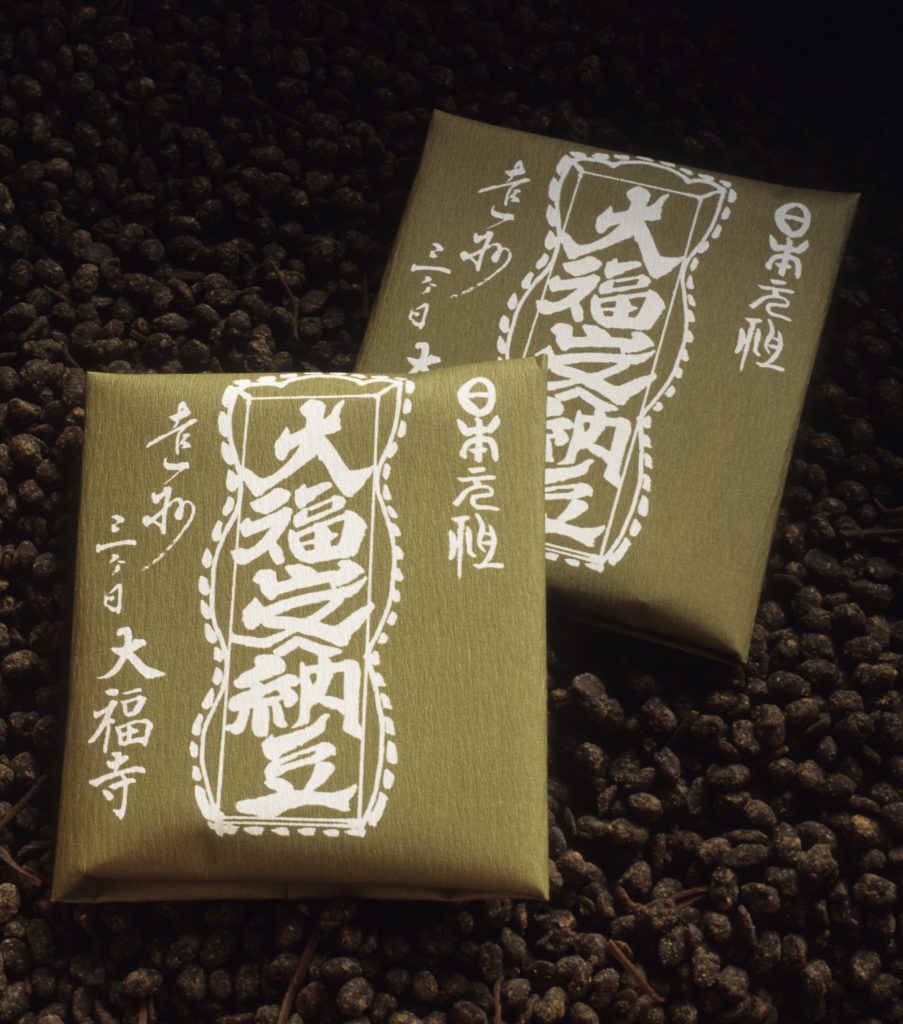
The ancient temple Daifukuji, in the Mikkabicho district of Hamamatsu, not far from Lake Hamana, has produced Hamanatto since the Muromachi period (1336–1573). The chief priest continues to make the dish by hand today. The natto is prepared in midsummer and left to age, then taken outside on a fine autumn day to dry in the sun. According to custom, the finished product is presented to the parishioners as a New Year’s gift.
Whereas the familiar sticky natto is mass produced by mixing steamed soybeans with the cultured bacterium Bacillus subtilis var. natto, Hamanatto is made following the predecessor’s instructions: waiting for the natural koji mold to inoculate the steamed soybeans, caring for the live koji mold, and allowing the microorganisms to do their work at their own pace.
Preparation of the spice karakawa is completed in June. Preparation of the natto does not start until mid July, during the height of summer, when the koji mold ferments best. Having performed the morning service, the chief priest, Mr. Noriaki Horiguchi, begins making the soybean koji at five thirty in the morning.
The process of propagating the koji mold on the steamed soybeans is called “growing a bloom of koji.” This is an important process that will determine the flavor of the natto. Two and a half bales of soybeans (150 kg) are added to a large pot with 14 liters of bubbling hot water for a quick boil, and drained while the core is still hard and the beans still smell green. The contents are then transferred to baskets and steamed slowly over charcoal.

photography : Hiroshi Ohashi
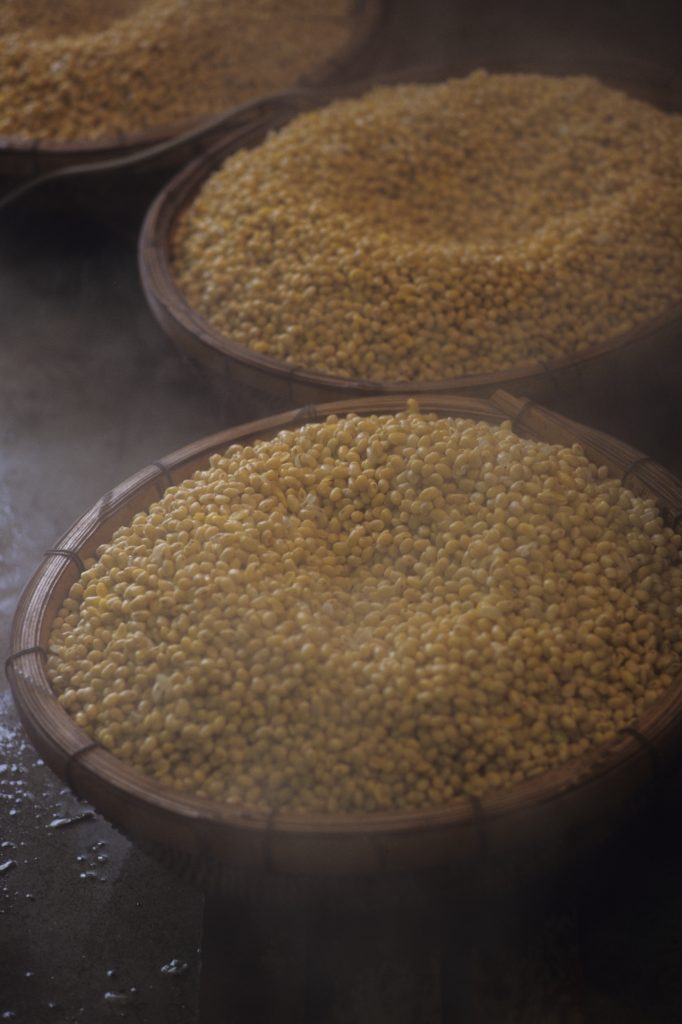

photography : Hiroshi Ohashi
The next morning, the soybeans are coated with parched barley powder and divided into wooden trays. Before long, honeybees attracted to the sweet scent appear out of nowhere.
Natural koji mold loves a good treat too. The soybeans coated with parched barley powder are designed to act as bait to lure the koji.

photography : Hiroshi Ohashi


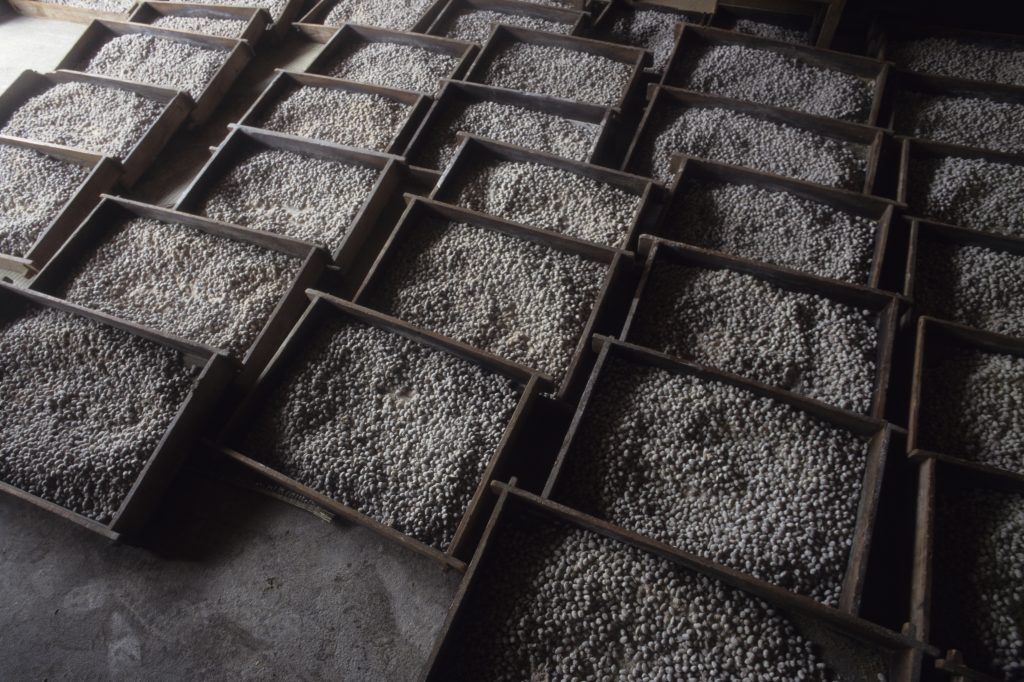
photography : Hiroshi Ohashi
Growing a bloom of koji—temperature control is the key
Two days after the trays are taken to the koji room, called muro, the koji mold begins to inoculate the soybeans. It’s easy to tell because the koji generates a lot of heat during fermentation. Now it’s a matter of keeping the mold happy and encouraging it to feed on the bait so that it produces the perfect soybean koji.
But things are not that simple. If the temperature gets too high, unwanted bacteria will ruin the flavor. The temperature must be checked and regulated morning and night to soothe the mold and keep it comfortable. On a hot day, the doors are opened to bring the room temperature down; and when it feels cool enough, the doors are closed to maintain that temperature. When we humans feel cool, the koji feels cool too. When we feel hot, it feels hot too.

photography : Hiroshi Ohashi
In about ten days a fluffy, yellowish green koji mold covers every inch of the soybeans. The perfect soybean koji that has formed makes the producer smile with relief and affection for the “bloom of koji.”
Mr. Horiguchi’s wife, Ruriko, says her mind is so filled with the koji that she can hardly leave the temple grounds during the summer.
“The koji mold is alive. It can’t be left alone, or it will go bad.”

photography : Hiroshi Ohashi

photography : Hiroshi Ohashi
On a fine day in October, the soybeans are taken out of the barrels and dried in the sun.
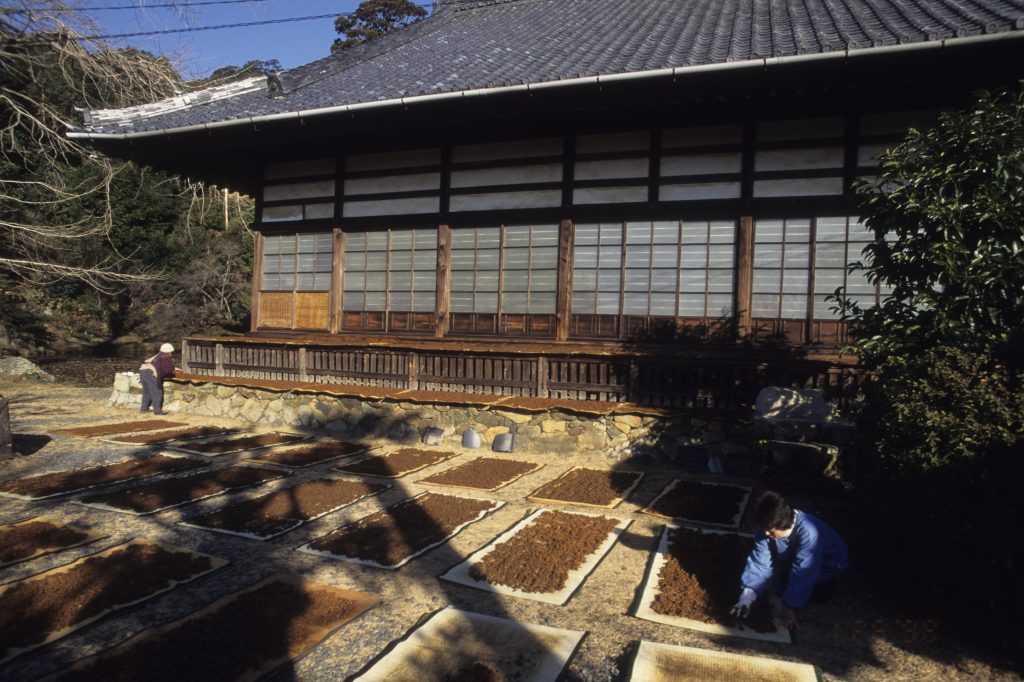
photography : Hiroshi Ohashi


How many priests have endured the sweltering heat to continue producing Hamanatto. The recipe for this unpretentious fermented soybean delicacy carries the weight of centuries of hard work, and is more valuable than any treasure lying in the temple’s grounds. It may even be worthy of being named a national treasure.
Making the forgotten spice karakawa
Each package of Hamanatto contains pieces of a pungent something.
The occasional complaint comes from first-time customers. “What is this foreign object, like a wood chip, in the product. I bit into it and my mouth went numb!”
Wood chip is not too far off. The foreign object in question is the pickled bark of the Japanese pepper tree, called karakawa. The ancient spice was believed to be forgotten in history about a hundred years ago.
The fruits of Japanese pepper are small and spicy, but the bark is so hot that just a tiny fragment is enough to wake you up.
“If you boil karakawa and release the water into the river, it will get eels drunk and draw them out. Small fishes will go numb and float to the surface too,” says Mr. Horiguchi, mopping the sweat off his brow. “That was how we caught fish and eels when we were little.”
Karakawa also serves as a natural preservative. When aged in barrels with the soybean koji, it repels insects and bacteria. The numbing stimulation must have been popular because karakawa comes up in records of tea ceremony gatherings dating to the Momoyama period (1573–1603). The common people in the Edo period chopped the bark and cooked it with the fruits in soy sauce and mirin to make a tsukudani of Japanese pepper. The piquant flavor helped ward off drowsiness and even stimulated the brain and improved the function of the internal organs, serving as a stomachic.
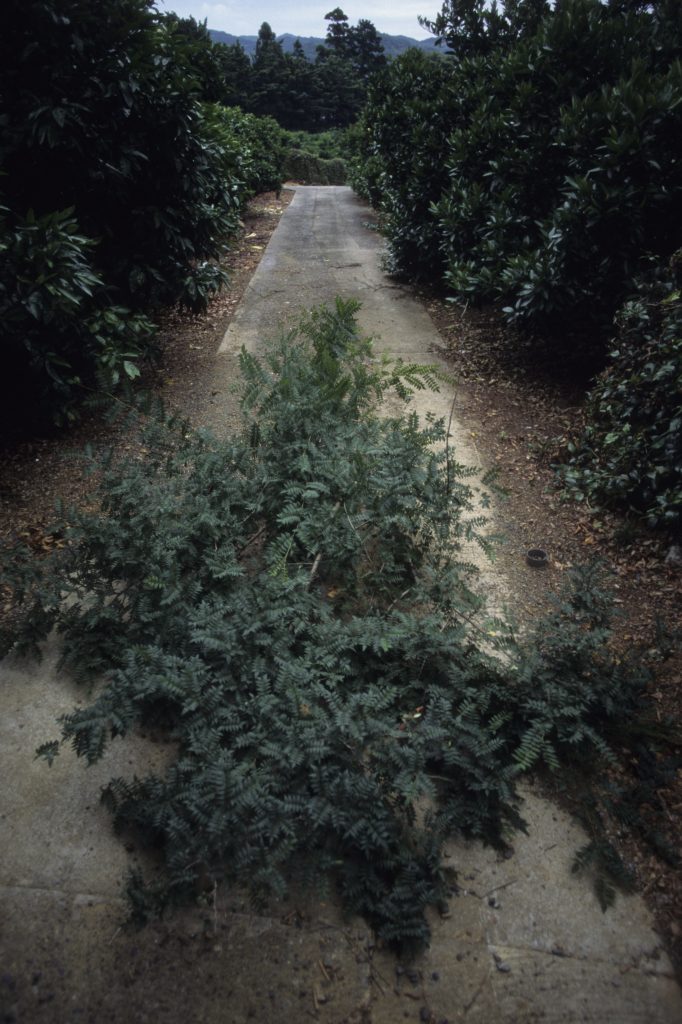
photography : Hiroshi Ohashi
The trunk and branches of a young Japanese pepper tree are boiled in an iron pot over firewood for about an hour. Just peeking into the pot stings the eyes. Once boiled, the bark is peeled off, its rough surface is scraped off with a spatula, and the inner bark is pickled in salt in an earthenware pot for a month.

photography : Hiroshi Ohashi

photography : Hiroshi Ohashi
Removing the outer bark is an ascetic feat. It is not the same as nipping the bud or picking the fruit. It means felling a very thorny Japanese pepper tree from the roots and transforming it into a spice.
“After working all day long, my fingers go numb and I can’t feel anything.” The thought of giving up has crossed Ruriko’s mind. But she always reconsiders because “there are people looking forward to the product.”
How many producers before her have reconsidered to keep the custom of making karakawa alive for hundreds of years. It’s not that old equals good. It’s that people look forward to the good, and the producer lives up to the people’s expectations, and the good is still here today.

photography : Hiroshi Ohashi

photography : Hiroshi Ohashi

photography : Hiroshi Ohashi
photography : Hiroshi Ohashi
Daifukuji Temple
220-3 Mikkabi-cho Fukunaga, Hamana-ku, Hamamatsu-shi, Shizuoka
* The copyrights for the photographs and articles published on this site belong to their respective right holders. Please note that appropriate steps may be taken in the event of any unauthorized use to protect these rights.