







As we sit down in front of the exhibit, we can’t help but gaze in bewilderment. A modern chair with a cantilevered two-legged structure, it seems at first glance like it might tip over once you sit in it. Yet, its innovative structural beauty was the result of precise calculations. This masterpiece is known as the Conoid Chair, designed by none other than George Nakashima.

George Nakashima was born in 1905 in the U.S. as a second-generation Japanese-American. His career began as an architect, and before the war, he worked at the office of Antonin Raymond in Japan. Raymond, a colleague of the legendary architect Frank Lloyd Wright, stayed in Japan after coming to oversee the construction of the old Imperial Hotel, leaving a significant mark on Japanese architecture. However, as for Nakashima, after returning to the U.S. and getting married, he reportedly visited Wright’s works only to feel a sense of disappointment.
Seeking work where he could take full responsibility from start to finish, Nakashima turned away from architecture and set his sights on furniture design—crafting pieces entirely on his own, from design to production. With the outbreak of World War II, Nakashima found himself living through difficult times in an American internment camp, where he met a Japanese carpenter. Unlike the the laid-back stance of Western woodworking, Japanese techniques were sharp and delicate. Nakashima learned these skills and later moved to New Hope, Pennsylvania, where he established his own workshop— the Conoid Studio, where the iconic Conoid Chair was born.

Nakashima, who disliked being called an artist and preferred the title of “woodworker,” eventually gained worldwide recognition for his craft. However, to this day, there are only two workshops globally authorized to produce his designs—the Conoid Studio and one other. That second workshop is the Sakura Seisakusho in Takamatsu. Nakashima visited the factory at the invitation of sculptor Masayuki Nagare and, impressed by the work of local artisans (The Sanuki Minguren Union), he formed a partnership with them. Since then, they have continued to create and release his beautifully crafted furniture.
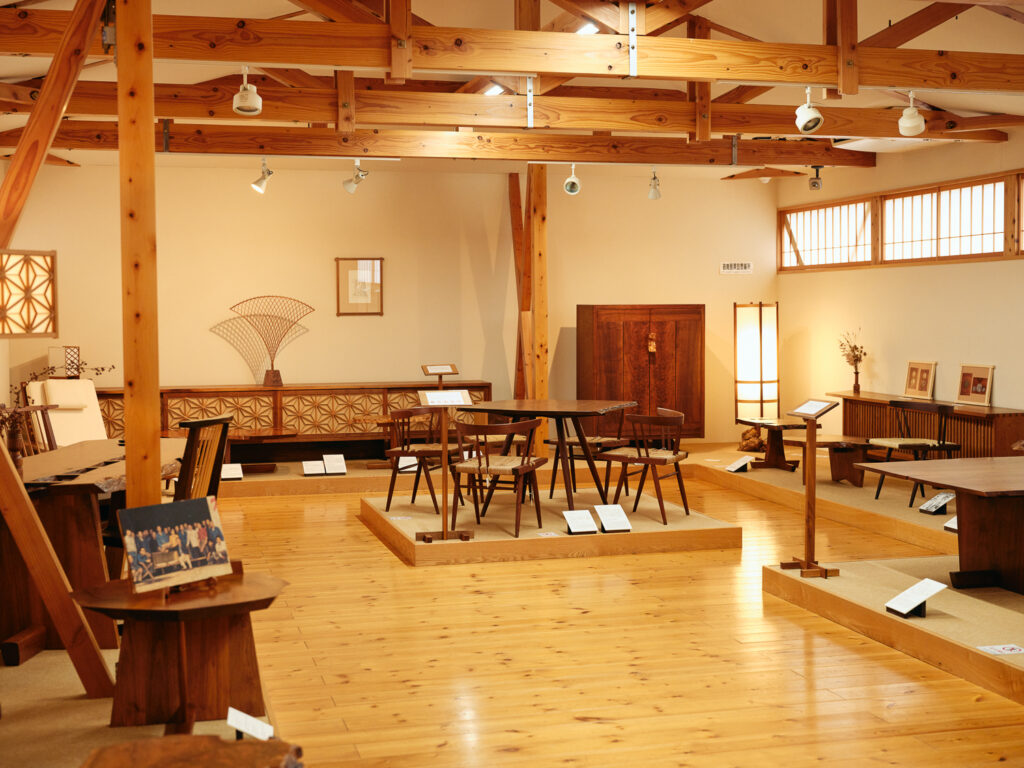
The spirit of Nakashima, which the Sakura Factory has inherited, can be closely experienced at the adjacent George Nakashima Memorial Museum. On the second-floor exhibition room, visitors can learn about his legacy and see his works up close, attracting many visitors from abroad.
“Nakashima, originally an architect, placed great importance on structure. Rather than embellishing, he focused on structural integrity, and I believe that’s why his furniture possesses such a timeless beauty,” explains one of the museum’s representatives.

Reflecting on the exhibits, we sip our coffee and listen to the staff’s conversation in the café space on the first floor. As we look up for a moment of rest, we notice the beam above the counter is covered with signatures of renowned figures—sculptor Isamu Noguchi, painter Genichiro Inokuma, and others. It feels as though we have caught a glimpse of the aesthetic spirit that defines Kagawa, the so-called “Art Prefecture.”