Story 02 | Growing rice and beans
“My family has been farming here for maybe 20 generations. I’ve been doing this work since I was 18,” says Kazushi Suzuki (62) as he takes us into his small farmside office. He extracts two business cards from a wallet with stubby, working-man’s fingers and lays the cards on the table in front of us — one reads “Kazushi Suzuki, Soybean Farmer,” and the other, “Kazushi Suzuki, Rice Farmer.” Each year his farm in Kozaki produces about 120 tonnes of rice and 40 tonnes of soybeans; about 90 percent of those crops are grown without chemicals, but he’s “working towards going totally organic,” he says.

Kazushi’s world here, surrounded by tools, plants, dirt, seeds and serenity, seems removed from the so-called sustainable-organic-ecological produce that ends up inside expensive supermarkets across Japan.
Kazushi’s concern is making good materials for people in the community. “I went organic about five or six years ago, I felt that if I wasn’t growing crops naturally, I wasn’t a real farmer,” he says. “With the organic people it’s not about the price, you focus on making good things, high quality, delicious things, but with chemical people it’s all about the price, which forces the farmers to make cheap stuff. Everybody wants to go the easy route,” he says.
Well, not everybody. Japan has a long history of marginal farmers taking the difficult route, and one farmer in particular, Masanobu Fukuoka (1913-2008), saw going natural as not just means of making good quality food, but creating a new way of life. Fukuoka begins his chemical-free-farming manifesto “The One-Straw Revolution” — one of the most important books of natural farming — by writing: “I believe that a revolution can begin from this one strand of straw … this rice straw may appear light and insignificant. Hardly anyone would believe that it could start a revolution. But I have come to realize the weight and power of this straw.”
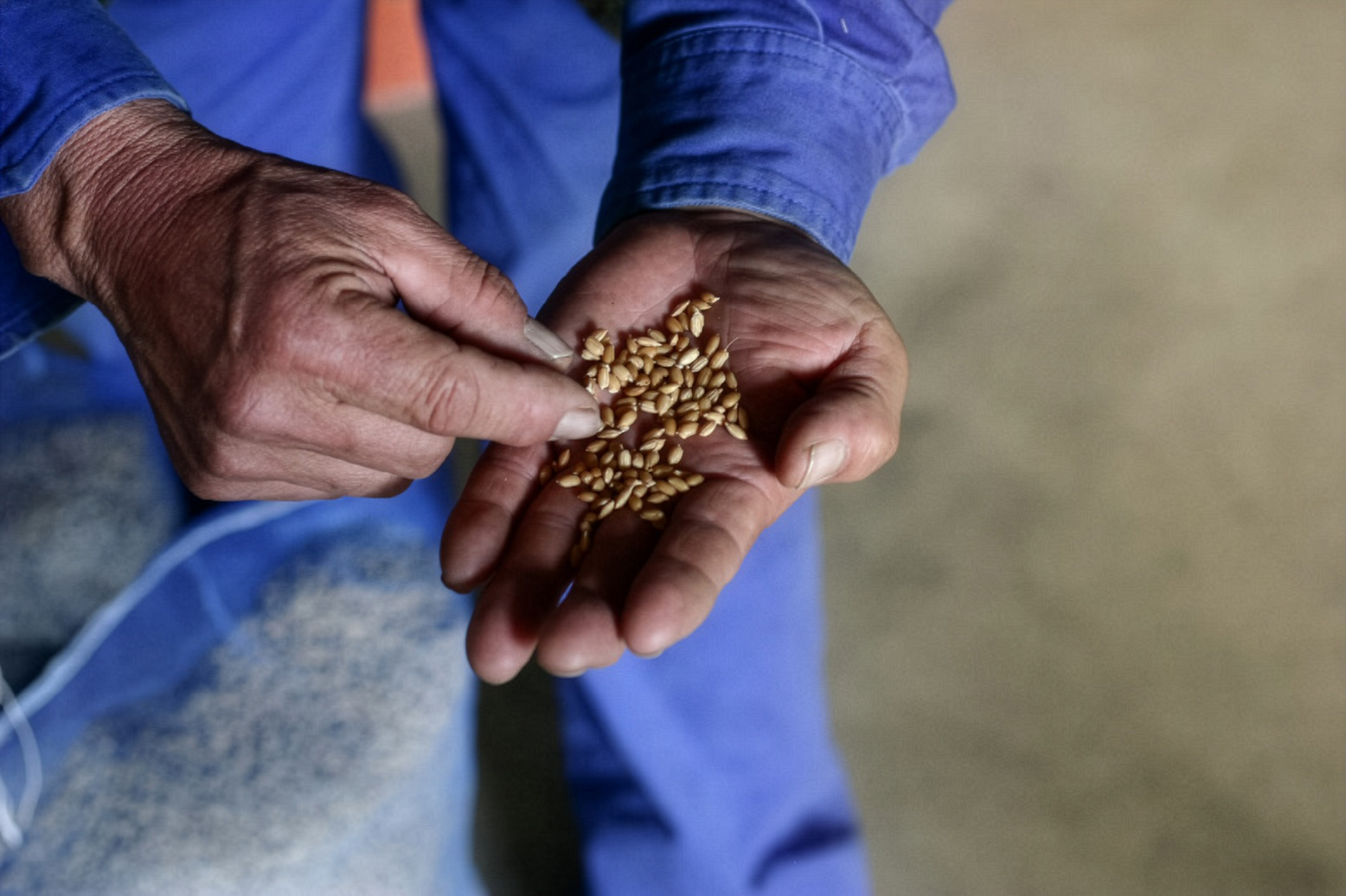
Part of the slight revolution in Kozaki is a slight reversal of the urban migration going on elsewhere in Japan, people are moving back in to Kozaki to create change with good food as the catalyst. Kazushi’s farm is supporting a whole ecology of these producers — from the natural Sake of brewery Terada Honke, to a nearby tofu factory. After talking, we ask him to show us his farm, but nothing has been planted yet, and the fields are untilled and bare. Instead he shows us the rice seeds he is about to plant, by ripping open a mesh bag and gently taking up a handful. He is looking for something as he rolls the seeds slowly across his palm, moving each seed back and forth and folding up his wrinkled face as he squints to look closely at the seeds. “There,” he says. And we look, and see a tiny stem, light and insignificant.
< PAPERSKY no.45(2014)>