







Seeking Jomon in the North
At the end of the Ice Age, rising sea levels caused the Japanese archipelago to separate from the continent around 15,000 years ago. From then on, it began its journey as a long, narrow chain of islands. Though surrounded by sea, its interior was already lined with mountain ranges. Rainfall from the heavens nourished the land, forests flourished, and countless rivers ran from the mountains through valleys and out to sea. There were no countries yet, no governing structures to speak of. Humans lived modestly, as part of the natural world, no different from plants and animals. That way of life must lie deep in our primal landscape, yet over the ages, we’ve neglected that dialogue with nature and begun to drift away from it. When did we fall out of the circle of coexistence we once shared with the sea, the mountains, the rivers, the trees and stones, the plants and animals?
I first turned my attention to the Jōmon culture—the foundation of this land—five years ago. It started with a growing restlessness over such questions, as well as a certain fleeting moment that sparked something in me.
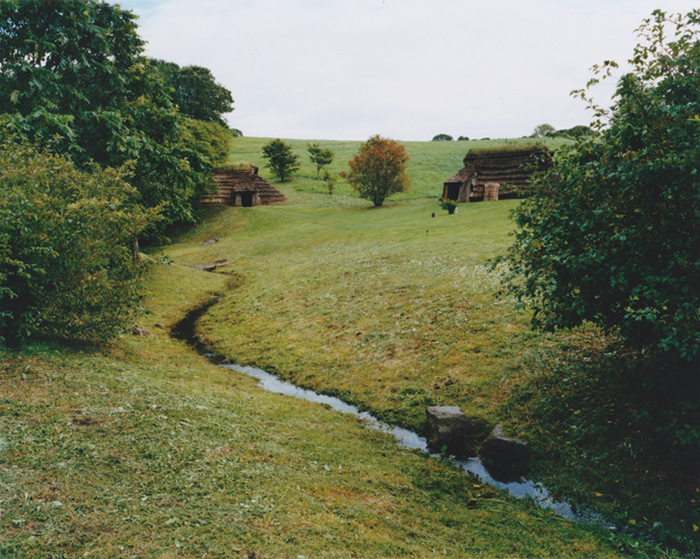
The reconstructed dwellings stand exactly where they once stood, with the original water source still flowing nearby.
One winter, while walking a mountain path in Akita with a friend, he casually said, “You know, the Jōmon people used to live around here.” Then, he bent down, picked up a piece of pottery from the damp ground right beside us, brushed off the sand with his palm, and revealed a Jōmon-era pattern. Smiling, he said, “Late Jōmon pottery.”
I blurted out, “Wait, we’re that close to the Jōmon era?”
He simply replied, “It’s all connected.”
Since then, whenever I travel across Japan, I find time to revisit Jōmon sites, again and again. I began to realize that Jōmon settlements and shell mounds weren’t limited to well-known regions like Tōhoku, the Yatsugatake foothills, or the Shinano River basin. They’re scattered throughout the Tokyo metropolitan area too—Tokyo, Kanagawa, Chiba. That changed the way I saw the whole landscape of the Japanese islands.
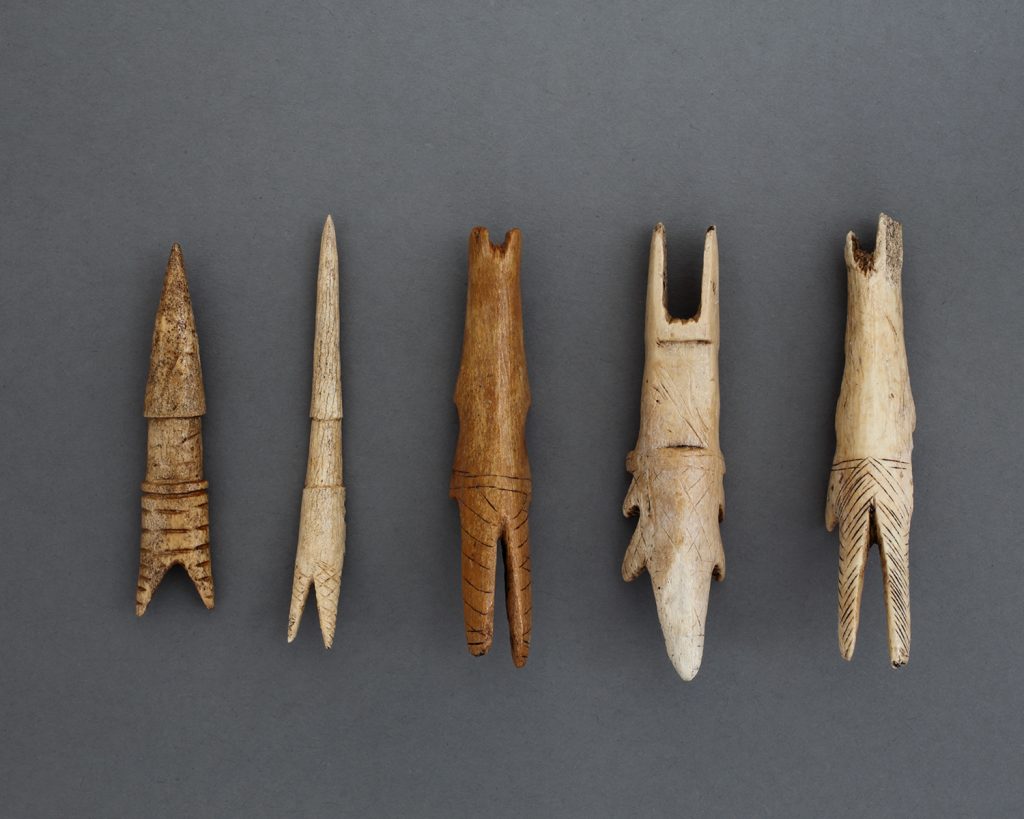
Irie-Takasago Shell Mound (Tōyako Town, Abuta District, Hokkaidō) Jōmon period, Late to Final (approx. 2000–800 BC) Collection of Tōyako Town Board of Education
The sharpened tip of a tool used to hunt marine animals such as seals and dolphins. Its surface is adorned with intricate patterns.
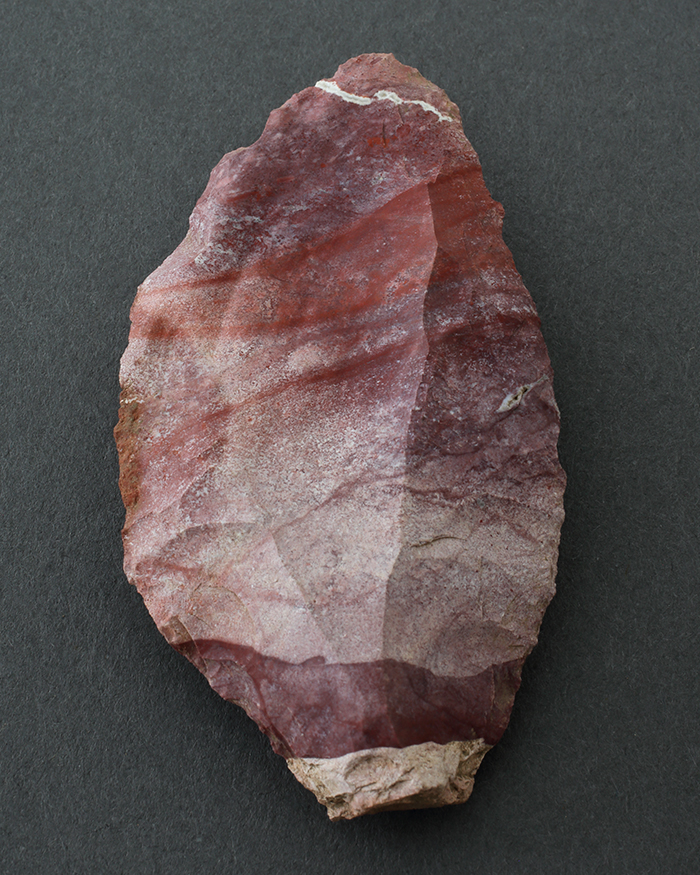
Nimaibashi (2) Site (Mutsu City, Aomori Prefecture) Jōmon period, Final (approx. 1000–300 BC)
Collection of Mutsu City Board of Education
Among the excavated artifacts was a stone tool that appears to be unfinished. Its vivid color draws the eye.

Jōmon period, Early to Middle (approx. 5000–2500 BC)
Near the site, a row of carefully arranged deer skulls was found in a nearby shell mound. Some scholars suggest that these mounds were not mere dumping grounds, but sacred spaces for sending off spirits.
This fall, I set out on a new journey to trace the Jōmon culture of the north. My destinations were Aomori Prefecture and the southern part of Hokkaidō—regions that once shared a unified cultural zone across the Tsugaru Strait and are home to many Jōmon archaeological sites.
From Nemuro on the eastern edge of Hokkaidō, I made my way to the Funka (Uchiura)Bay area in the south, crossed by ferry from Hakodate to the Shimokita Peninsula, and traveled down to Mutsu City, then Aomori City. On this trip, I touched the tools and ritual objects of the Jōmon people—who lived by hunting, gathering, and fishing—and in doing so, I gained a tangible sense of their way of life.
In a conversation with Abe-san, director of the Hakodate Jōmon Culture Center, we explored how the Jōmon people may have perceived time. He told me, “It seems like the Jōmon people didn’t divide time into past, present, and future the way modern people do.” In other words, perhaps they viewed time as a continuum, or a unified whole rather than distinct segments.
This way of thinking is echoed in the proximity of their living spaces and graves, in the earthen masks and decorated clay items thought to be ritual implements. Even the patterns on their pottery tell a story: similar motifs found at the Sannai-Maruyama site are also unearthed across the sea in southern Hokkaidō, and remarkably, some of these forms were passed down for thousands of years with little change.
In the modern world, where everything changes at breakneck speed, it’s becoming harder to preserve even centuries-old festivals and traditions. But in the Jōmon era, such continuity was made possible through the living wisdom of the people, embodied in various forms.
遺跡01_0001.jpg)
During excavation, a large number of pottery vessels were discovered above the remains of a dwelling.
遺跡02_top-1024x819.jpg)
At the center of a pit dwelling remains a clearly defined hearth, once used for fire, hinting at what life was like at the time.
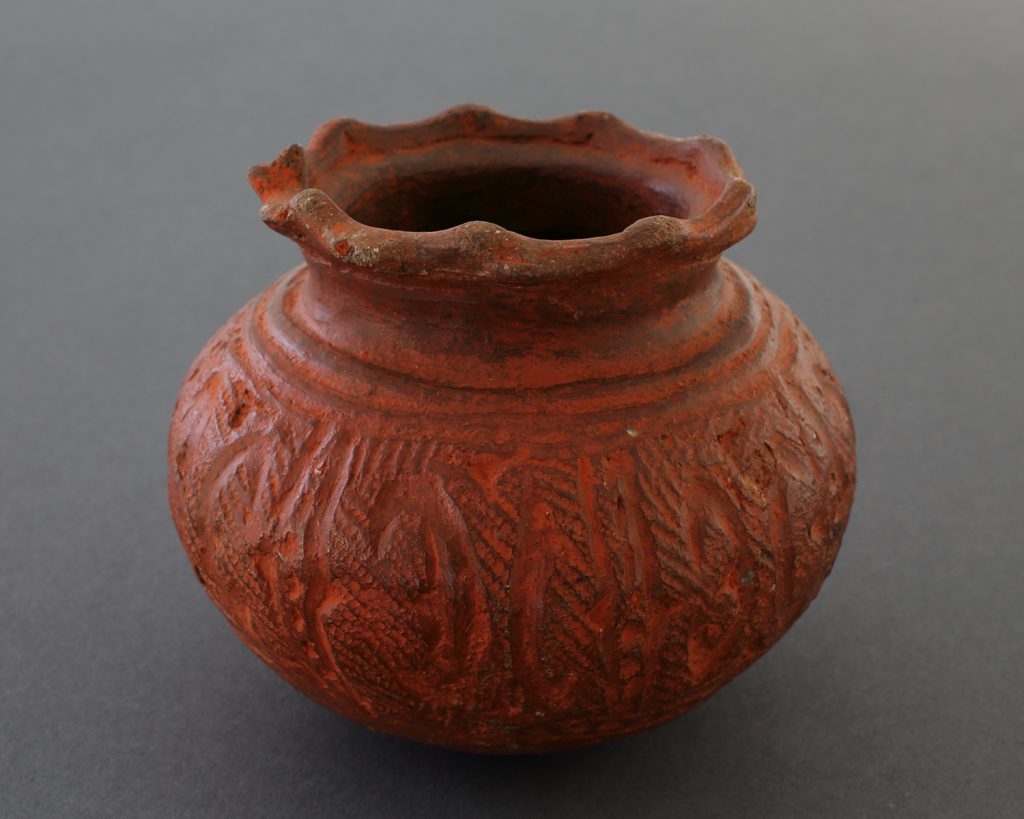
Nimaibashi (2) Site (Mutsu City, Aomori) Jōmon period, Late (approx. 1000–300 BC)
Collection of Mutsu City Board of Education
Many Jōmon-period artifacts are decorated in vermilion or red. Even after several millennia, the deep red of the bengala pigment remains strikingly vivid.

Nimaibashi (2) Site (Mutsu City, Aomori) Jōmon period, Late (approx. 1000–300 BC)
Collection of Mutsu City Board of Education
This clay mask, thought to have been used in ritual ceremonies, bears a gentle expression. The markings around the cheeks and mouth may represent tattoos.
Beneath our very feet lies the Jōmon world, buried in layers that go nearly 12,000 years deep. To behold their enduring gaze, we need only begin by carefully observing the tools and objects they left behind.
If those who will one day shape the future come into contact with what has been passed down through the ages, and forge new paths from it, then perhaps the return of a time when humans once again converse with nature might not be so far off after all.
<PAPERSKY no.46(2014)>

The spout of this vessel appears to symbolize masculinity. It was reportedly unearthed alongside another vessel thought to represent femininity, both from the same dwelling site.
Jomon Fieldwork | Nao Tsuda × Lucas B.B. Interview
A conversation between ‘Jomon Fieldwork’ Photographer and writer Nao Tsuda and Papersky’s Editor-in-chief Lucas B.B. The two discuss the ways Jomon culture continues to play an important role in modern day Japan. The video was filmed at Papersky’s office in Shibuya in conjunction with Tsuda’s exhibition “Eyes of the Lake and Mother Mountain Plate” held at the Yatsugatake Museum in Nagano.
Nao Tsuda | photographer
Through his world travels he has been pointing his lens both into the ancient past and towards the future to translate the story of people and their natural world.
tsudanao.com