







Nagai-san pens gentle, insightful essays and organizes circles of discussion. That is, she does both the writing and the interaction. Most people do only one or the other, so her work amazes me. I’m glad I got to chat with her in person.
ー Seiko Ito
Ito: I hear you like going to botanical gardens. Do you have any favorites?
Nagai: I’m from Shibuya, and Shibuya runs the smallest botanical garden in Japan. Ever since my teens, I’ve loved to hang out there, just sitting on a bench surrounded by the plants and getting lost in a book. Now there’s a café in the garden, and it’s become a stylish place where couples go to take selfies.
Ito: That’s true. It’s more of a photogenic spot now.
Nagai: In the Kamagasaki area of Osaka, there’s a triangular space where old men tend the grass and grow all kinds of plants. I have a soft spot for those gardens that are just there out of the blue in the city.
Ito: I’ve seen one of those in Nerima. The property is owned by the city, but the people in the neighborhood are growing all sorts of fruits and vegetables, and there’s a sign saying you can pick any crop you like. So if you get hungry, you’re welcome to harvest and enjoy a tomato or orange. I wish they would do that with all vacant properties. Instead of making a parking lot, they should grow a garden, even if it will last for only a couple of years.
Nagai: Oh definitely. By the way, did you know there are masked palm civets living in Shibuya? If you look up, you can see them walking on the electric cables.
Ito: Really? I’ve heard there are bats living in the city too. If you look closely in the evening, you can see them fly into the alley between the buildings. There must be many animals that we don’t notice just because we aren’t used to spotting wildlife.
Nagai: Now that’s a substantial issue. As long as we humans go on believing the city belongs to us alone, we’ll never see the other animals living around us. That also leads to the question, who does the land belong to.

Ito: That question applies to a tree too. A single tree is home to all kinds of insects and parasites and birds. In essence, every tree is a forest with a diverse ecosystem. That’s why I say chopping down a single tree is like felling an entire forest.
Nagai: It makes you wonder how we became so blind, and so inclined to clear away entire forests. Those are the kinds of questions that pique my curiosity lately.
Ito: I heard that long ago, the trees on Yakushima Island were objects of worship and protected from logging. But the trees were needed for timber. So what happened was a Buddhist priest was sent in to convert the island’s residents and alter their sensibility and teach them that it’s OK to cut down the trees. I believe something like that happened all over Japan around the Meiji period.
Nagai: Sorry to go off track, but I promote “philosophical dialogue” in various settings, and one time at the end of a session at a company, a participant said So my department manager was human after all. That sensibility is very important. It leads to the next question, why don’t we see the manager as human, and by extension, why don’t we see every tree as a forest. We need to keep asking what is numbing our sensibility, otherwise humanity is heading toward a dangerous place.

Ito: Following that line of thought, the pursuit of wealth was traditionally considered vulgar, until Christianity came along and said being wealthy isn’t bad. In the sense that religion served to alter a people’s sense of values, that’s the same story as Yakushima Island. Similarly, the people at the company were permitted to see the department manager as nonhuman because the company’s sole purpose is to make a profit.
Nagai: Seeing a person as human requires some depth of insight, don’t you think? Every person is a tiny world containing an infinite sea of knowledge, experience, and memories. To set all of that aside and see only the person’s position in the company seems to be a basic problem of cognition. That cognition is clearly influenced by the company’s business ethics. And yes, I would say an influence that powerful verges on religion.
Ito: That’s what I think. If “god” so wishes, sadly, people are ready to part with their morals and principles. All this talk reminds of [the illustrator] Jun Miura. A while back, he and I were invited to an exclusive event by Beat Takeshi [Takeshi Kitano] at a venue seating only a few hundred. Just before showtime, a message arrived from Miura-san saying he can’t make it because his son caught a fever. Well, that blew my mind. It was a work-related invitation, we had platinum tickets coveted up and down Japan, and here Miura-san was choosing his family over all that. What’s up with his sense of values, I thought—he follows a totally different religion!
Nagai: It’s interesting that he put his family first, to nurse his sick child no less. Do you put your child first too, Ito-san?
Ito: I can’t help thinking about work, but whenever I do, Miura-san pops into my mind, and I remind myself not to go against his religion. Now, if I need to both work and look after my child, I go ahead and take my child to the studio. Everyone is happy to have a kid around, and they help look after it too.
Nagai: So your child is giving your cognitive boundaries a shake-up.
Ito: Oh sure. My child has taught me that it’s OK to take a child to work.
Nagai: Speaking of children, during one of my dialogues at a temple in Shizuoka, a three- or four-year-old child came up with the question Is Mt. Fuji necessary? As the fifty or so adult participants held their breath, I asked the child what made him wonder that. He said Because Japan is already beautiful enough without it, and that caused quite a commotion. Children can zoom out to the biggest picture or zoom in on the finest detail. The scale of their questions seem to be filtered through a divine lens, and they always leave adults flustered.
Ito: That dialogue sounds mythical, that’s for sure.
Nagai: It does, doesn’t it? In another session I hosted online during the pandemic, I asked a bunch of university students to draw a picture of their classroom, and the 200 or so participants drew a nearly identical scene. There were no desks or blackboards. All the pictures viewed the entire room from behind, with the professor standing on the platform in the distance and about 30 seated students.
Ito: That’s a perspective drawing of a dream or out-of-body experience.
Nagai: We talked about whose perspective it was in the drawings, and at the end of the day, the students were shocked—they were drawing from a memory that they thought was their own but was actually nobody’s at all.
Ito: I see. So in order to see the essence of a matter or share each other’s sense of values, people need to engage in dialogue. Like we did today.

Japanese Fika Table
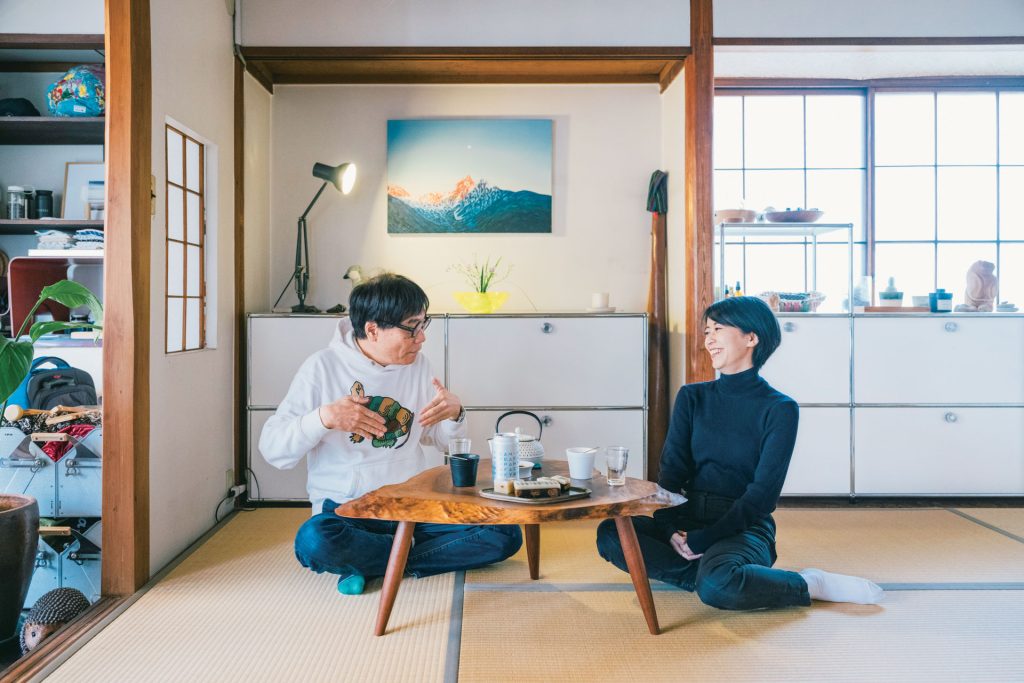
Tea:Tea Flower Tea from Tea Factory Gen
Tea Factory Gen uses tea leaves harvested from native species of tea tree grown without fertilizer or pesticide at an elevation of about 400 meters in the Sera Kogen highlands of Hiroshima Prefecture. Tea Flower Tea is a sencha, or green tea infused with tea flowers with the gentle scent of daffodil.
Sweets:Jazz Yokan from Yufuin Jazz & Yokan
Yokan designed like a piano keyboard gives you musical inspiration. Dried fig is kneaded into this subtly sweet jelly dessert made with azuki beans grown in Japan and brown sugar from Okinawa Prefecture.
Flowers:Lovely landscape of tiny blue flowers
Lapeirousia, a flower of the family Iridaceae endemic to southern African, is paired with beargrass in a modern vase for a not overly sweet arrangement. Vase by Birbira × Qualia Glassworks.
Rei Nagai, Philosopher
Born in 1991 in Tokyo, Rei Nagai promotes “philosophical dialogue” in settings such as schools, companies, temples and shrines, museums, and local government offices. She also contributes essays and other writings to various media. Publications include Suichu no tetsugakusha tachi (Underwater Philosophers, Shobunsha). Nagai loves poetry, botanical gardens, and going on elaborate walks.
Seiko Ito
Born 1961 in Tokyo, Seiko Ito is an author and creator who works in a spectrum of expressive genres including literature, film, stage, music, and online platforms. His latest publications include Warera no Makino Tomitaro! (Our Beloved Tomitaro Makino!; Mainichi Shimbun Publishing) and Ima sugu shiritai Nihon no denryoku: Asu wa kocchi da (Electric Power in Japan: Quick Guide to Tomorrow; Tokyo Kirara).