







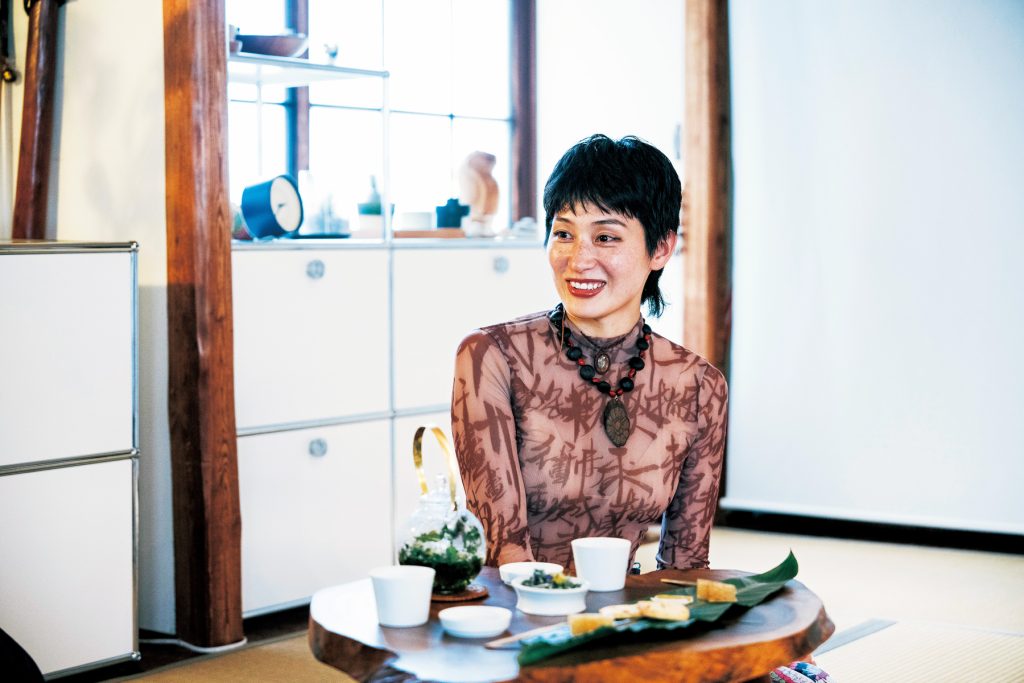
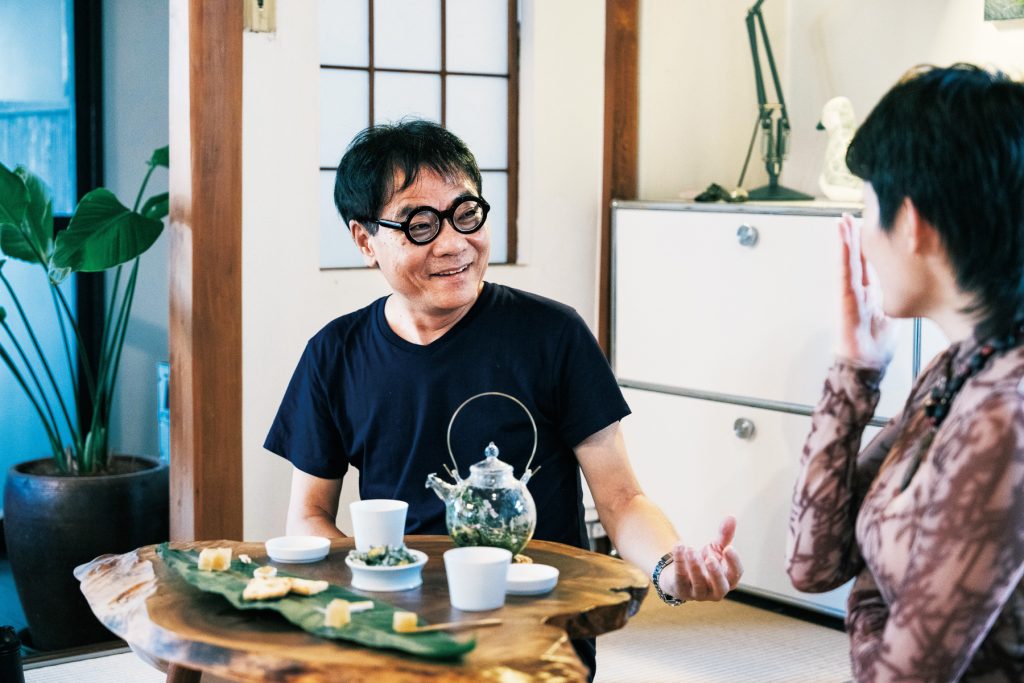
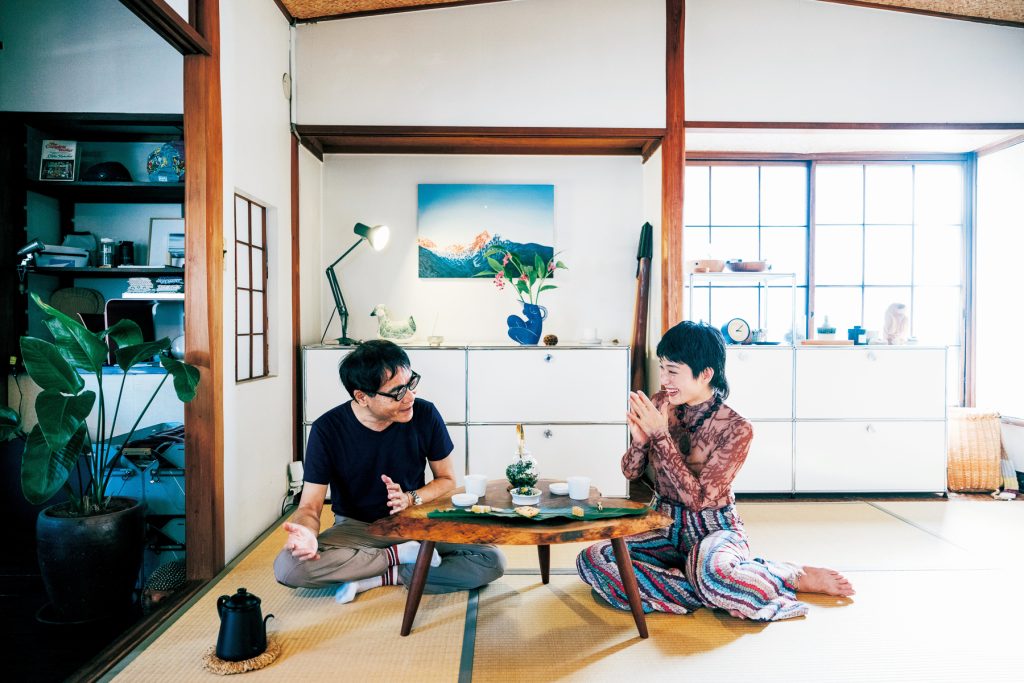
Our paths have crossed many times before, but we never really got to sit down and talk until now. This relaxed setting was perfect for chatting over tea with KOM_I. We enjoyed a tete-a-tete as delicious as the refreshments!
ー Seiko Ito
Seiko: When did you get back from South America?
KOM_I: I came back from Peru yesterday. Until just three days ago, I was at Machu Picchu.
Seiko: Really! My favorite foreign country is Peru. I’ve been there twice. One time I went to see the Nazca Lines, not by plane but by car. It took six hours on the local highway. Nobody travels by ground, you know. There was an ancient mummy poking out of the desert from the waist up.
KOM_I: What!
Seiko: No kidding, the end of the wrapping cloth was flapping in the wind. I was shocked—“Excuse me, that’s a mummy over there!” But the locals were like, “So what? They’re all over the place.” For them, it’s no big deal. Neither are the Nazca Lines. I found bizarre spiral shapes that no one knew about, drawn in a sports ground.
KOM_I: I know what you mean. Peru has so many mysteries that they can’t take care of them all. There was an archaeological site near Lima that had become a playground where groups of kids were riding their bikes. Did you see the dry stone walls in the ancient ruins in Cuzco and Machu Picchu? The stones are cut into square blocks, some with the edges curved so as to fit perfectly with the blocks on either side and behind. The joints are airtight, as if the stones released gas bubbles to fill the gaps. The Incan builders used techniques that architects today can’t imitate, and the strange thing is, the people there don’t really care. I guess that’s just another one of the wonders of Peru. Never mind. I love Peru purely for the food too. Peruvian cuisine is my favorite in the whole world.
Seiko: The food is delicious, isn’t it. I could go on about the potatoes alone. There’s no comparison. The native varieties have such a rich, strong flavor. Amazing.
KOM_I: Exactly. My favorite dish this time was Peruvian sushi. It’s a roll typically with avocado and deep-fried shrimp, and maybe a drizzle of olive cream sauce. Flexible and fun.
Seiko: How long were you in South America?
KOM_I: Last year, I was in the Amazon for two months to give birth. This year, I was in the Brazilian municipality of Salvador for three months. I also traveled through Mexico, Peru, and other places in Latin America.
Seiko: You’re into that zone.
KOM_I: Salvador was the center of the Atlantic slave trade in all of Central and South America, so a very large percentage of the residents today identify as Black. They practice a blended form of Christianity that is syncretized but clearly more strongly influenced by the original African religions, involving chants and dances and spiritual possession. I find that incredibly curious.
Seiko: In Peru, the indigenous religion was covered up by the religion brought from Spain. Literally, the Christian cathedrals were built right on top of the Inca temples. It gives you food for thought about the cruelty of invasion and oppression, and at the same time, what was so fascinating about this land that it had to be conquered.
KOM_I: It does make you wonder. Cuzco has a lot of churches too. As the former capital of the Inca Empire, it had many places of religious worship, which were then taken down and covered up with just as many cathedrals. But the Catholic structures aren’t the big attraction now. The tourists are flocking to the Incan ruins, peeling back the layers of colonialism that were obscuring the city’s original heritage. In the world of art too, museums in Sao Paulo and Mexico are displaying anti-imperialism works in the hope of challenging their bleak history and shaping a brighter future.
Seiko: Now that you’re back in Tokyo, is it exhausting to navigate the crowds?
KOM_I: Well, it’s only my first day, so everything still feels fresh. I’d forgotten it’s OK to flush the toilet paper.
Seiko: Like a tourist in your home country.
KOM_I: I grew up and went to school in Japan, so even while I’m traveling overseas, I like to keep up with the social and political issues in Japan. I noticed komochi-sama is a buzzword. Why pick on “privileged parents” for taking parental leave?
Seiko: You know, when I was pushing the stroller in the street, everyone seemed happy to lend a hand. I think it’s only a few insensitive remarks that are spreading online. Amplifying spite is a human weakness. We need to resist it and share our stories about good things and kind people.
KOM_I: It might be just me, but my experience of traveling says people are kinder in places with a poor reputation for public safety. Like Salvador—the people there are honest and kind. If I forgot my wallet, for instance, I would be more worried about how to get home in Japan. In South America, I could just holler for help, and chances are the people nearby would help me find money or even lend me some. That friendliness gives me hope in humanity.
Seiko: I have an idea. Why don’t you import kindness from South America? We Japanese have a soft spot for everything foreign, you know.
KOM_I: That’s true. What should I do?
Seiko: Just share posts from South America about the good things that happen to you in such and such city. Tell us that the people are friendly and kind.
KOM_I: That reminds me of my Peruvian friend who follows two rules for the good of today’s society. One, he never takes his phone out of the house. Smartphone is a distraction that stops people from talking to each other, so it stays home. And two, he makes conversation with strangers in the taxi or on the bus.
Seiko: That sounds like a sure way to recognize people aren’t all bad.
KOM_I: Yes, but I can also see how awkward it might be to talk to a stranger in Tokyo.
Seiko: It’s getting worse every year. Now might be the peak of oversensitivity. Let’s say someone offers his seat to a granny, and she says, “No thank you, I’m fine.” His feelings are hurt because she rejected his kindness, and he swears never to give up his seat for a bitter old woman again. He stops trying way too quickly.
KOM_I: He’s very fragile.
Seiko: Wouldn’t it be great if the bystanders in the train would chime in and say “Bravo!” or “Nice try!” or “Well done!” In the old days, people weren’t afraid to do that. All uncles were nosey buttinskies.
KOM_I: Don’t you think it’s important to talk about unimportant things?
Seiko: Owarai comedy is fine on TV, but lately everyone wants to build up to a punch line in casual chitchat too. No punch line needed. Ordinary aimless small talk is far more interesting.
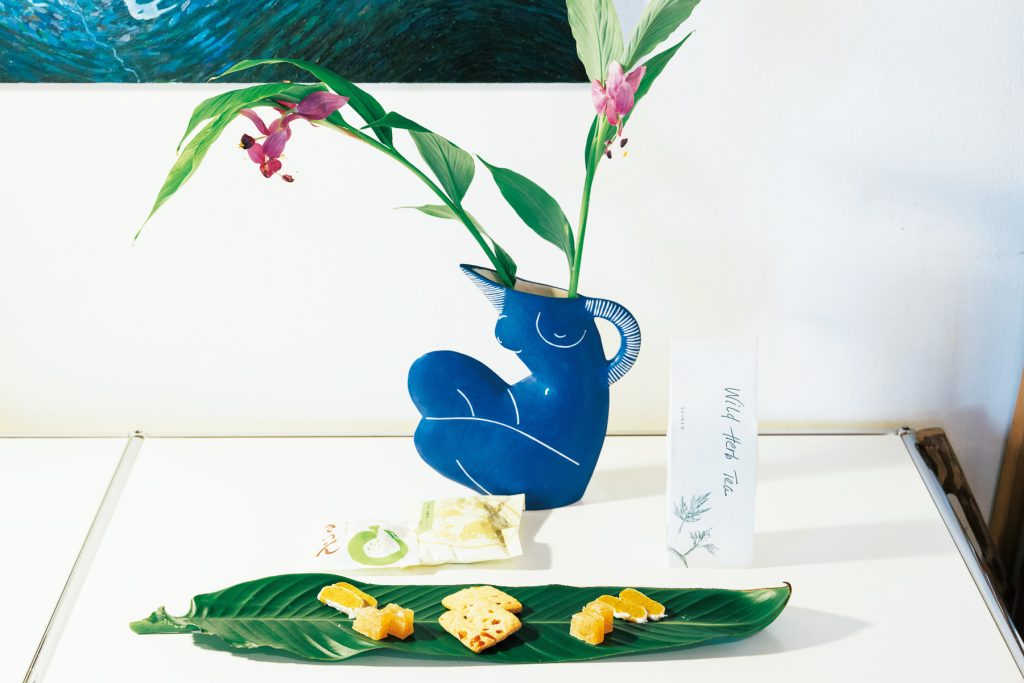
Japanese Fika Table
Tea:Wild Herb Tea from SUIGEN
Based in Oita and Okinawa prefectures, SUIGEN offers herbal products made from flowers and plants grown in the brand’s own farm. Wild Herb Tea blends Japanese mugwort with dandelion, Japanese mint, and other herbs picked from the mountains behind the studio to deliver the fresh taste and clear, stimulating scent of mint. Tea set by Swedish designer Ingegerd Raman.
Sweets:Kippan, Tougatsuke from Jahana Kippan, and Amanatsu Cookie from Momokusa
Traditional Okinawan sweets dating back to the era of the Ryukyu Kingdom. Kippan is made by kneading simmered citrus fruit from the Yanbaru region of northern Okinawa, and Tougatsuke with juicy winter melon boiled down in sugar. Cut into thin slices, both make the perfect accompaniment to tea.
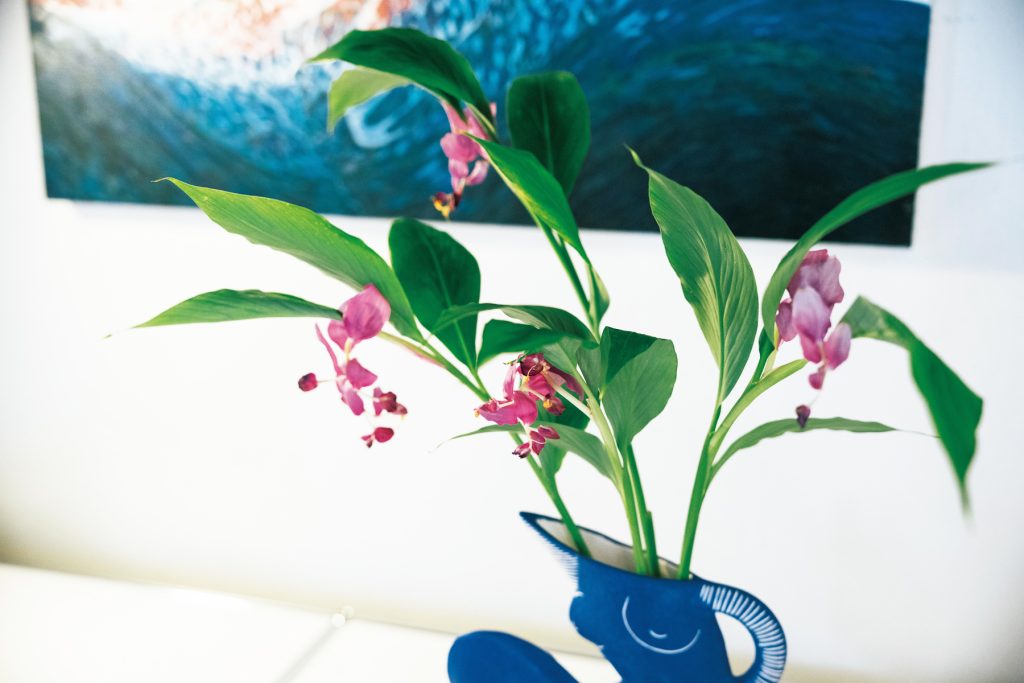
Flowers:In the embrace of a cozy breeze
Globba is an exotic perennial herb of the ginger family native to Southeast Asia and India. Arranged in a flower vase celebrating the female figure by British potter Jude Jelfs.
KOM_I, Artist
KOM_I was born in 1992 in Kanagawa Prefecture. Following her departure from the music group Wednesday Campanella in 2021, she currently works as a solo artist exploring the theme of views on life and death. In July 2023, KOM_I and her partner, the cultural anthropologist Akimi Ota, stayed at an Amazon village and gave birth to their first child.
Seiko Ito
Born 1961 in Tokyo, Seiko Ito is an author and creator who works in a spectrum of expressive genres including literature, film, stage, music, and online platforms. His latest publications include Warera no Makino Tomitaro! (Our Beloved Tomitaro Makino!; Mainichi Shimbun Publishing) and Ima sugu shiritai Nihon no denryoku: Asu wa kocchi da (Electric Power in Japan: Quick Guide to Tomorrow; Tokyo Kirara).