Story 02 | Cutting stairs into a mountain
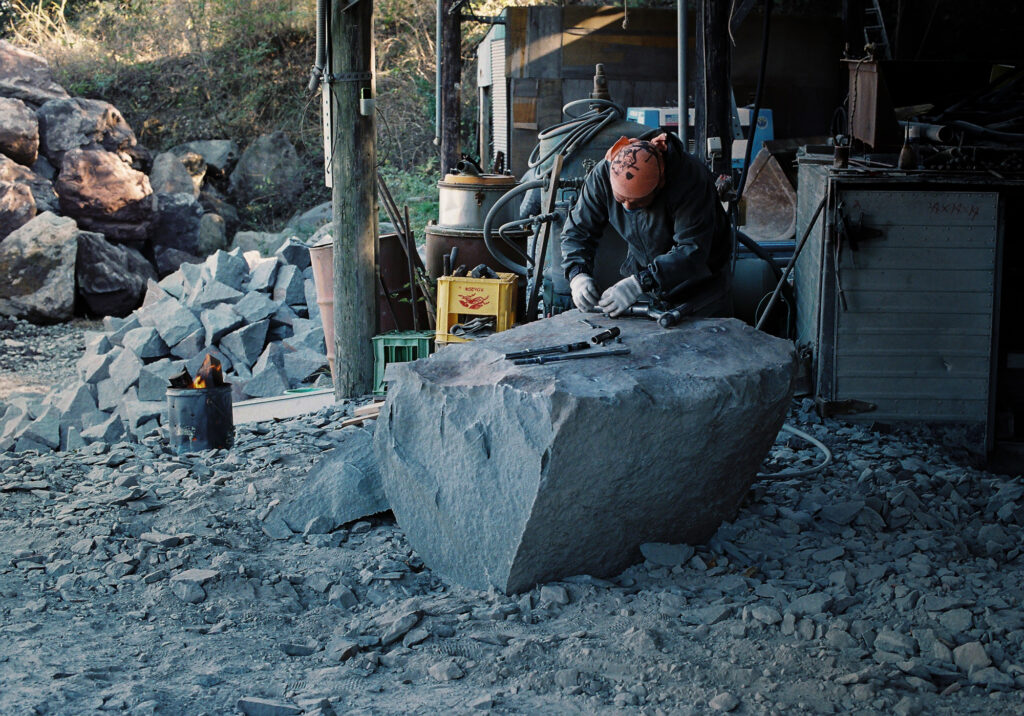
Fifteen thousand years ago, when Japan was almost uninhabited, Mt. Hakone erupted. Volcanic ash blanketed the country and lava flowed out, almost all the way to the Pacific Ocean on Japan’s east coast, below modern Tokyo. When the lava cooled, part of it formed a mountain which the Japanese would later call Komatsu. Endo has spent his life cutting stones from this mountain, using pneumatic drills, construction equipment, and explosives. “We know what we’re looking for,” he says, taking a short break in his makeshift on-site tearoom, “first we dig through about ten meters of mud, then ten meters of bad rock, and under that is the Komatsuishi stone we need.” He points to an unpolished, dull grey slab sitting on a bench, which will later be polished to a brilliant speckled blue.
It can take years to reach a vein of this precious blue tinged stone, but it’s sold in seconds, “there is a lot of demand for high quality stone,” he says, “but it’s getting difficult to find, most of it has been extracted.” Endo’s company quarries the rock from far up the mountain, above the town of Manazuru. He and his five workers split the stones into manageable chunks which are sold to stone working companies, like Takebayashi’s, to be polished and crafted into gravestones or sculptures. Polishing and carving is dangerous, but quarrying is deadly. “This is incredibly dangerous work,” he says, “people die.” Endo started work here when he was 24 to cover the workload of his brother, who was accidentally crushed by a stone during blasting. “I’m the second oldest, so I had to take over. I didn’t want to do this job, but then again, I didn’t want to study either.
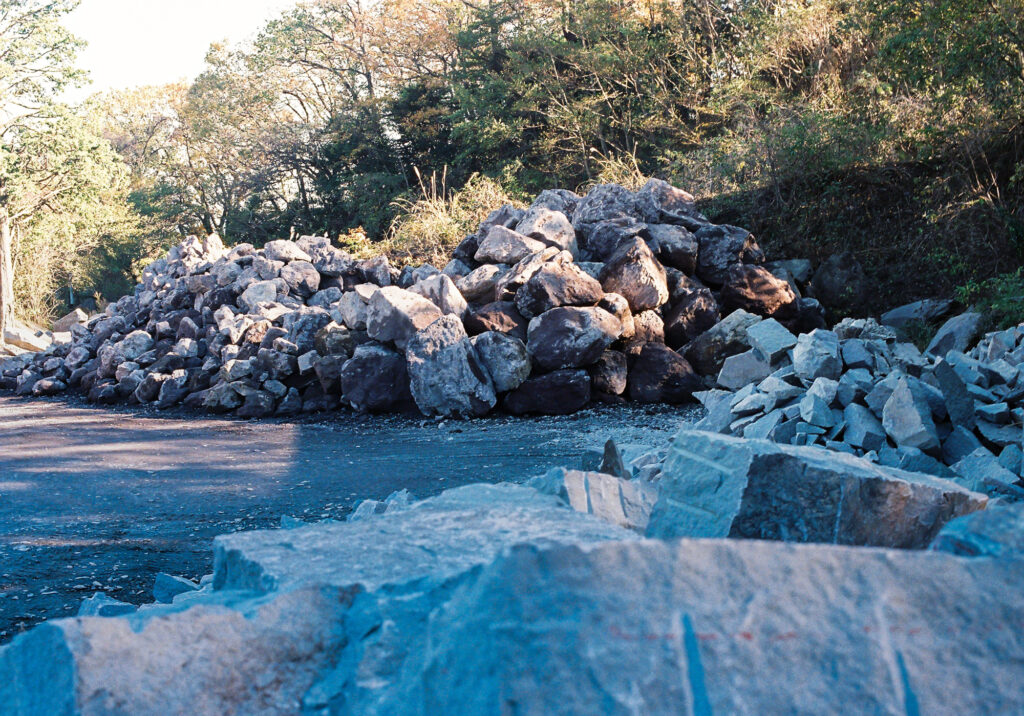
“Outside the tiny prefabricated tearoom his two workers are using drills to break the granite into smaller pieces. The noise ricochets off the stone wall behind us. Other workers are in the nearby quarry, operating heavy machinery. We can’t hear any explosions, “we don’t use dynamite anymore,” he says, “…too dangerous.” He shows us how the rocks are removed by cutting enormous sets of stairs into the mountain, a technique which has greatly reduced the blasting accidents. Despite safer and more efficient extraction methods it’s harder to find good stone today because so much has already been removed. “Eight meters is the longest piece of good, blue tinged stone we ever found,” says Endo. Over one hundred years ago, high quality stone could be cut closer to the ocean and easily shipped to Tokyo and other ports across Japan. This was what helped make the stone well-known, it was unique, abundant in Manazuru and easily distributed. Now it isn’t abundant or any easier to transport than stones from abroad. And it’s becoming rarer because “everything is moving so fast,” explains Endo, “the mountain is wearing down faster, stones are being extracted faster.” Endo is a third generation stone worker, but whether there will be any Komatsuishi stone for the next generation is questionable.
< PAPERSKY no.44(2014)>